
AI Won’t Make the State Smaller. It Will Re-Layer It.
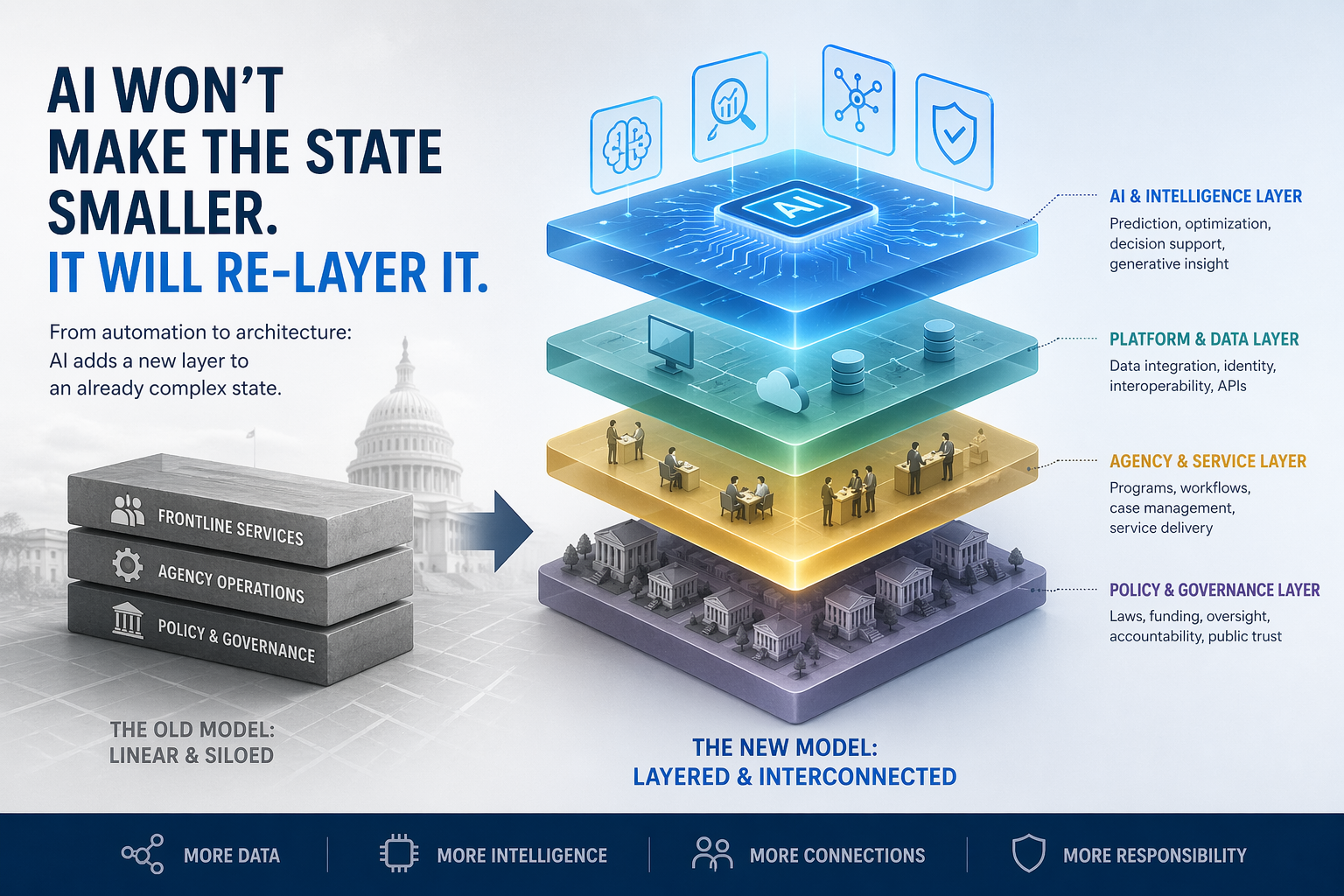
I broke down 59 government and public administration roles. The paperwork layer is compressing fast. But AI is also increasing service demand, moving decision power upstream, and making legitimacy more valuable than ever.
1. The Wrong Question
Most discussion about AI in government starts with the wrong question:
Will AI replace government workers?
That framing is shallow.
Government is not just another white-collar sector. A company is judged mainly by margin, speed, and output. A state is judged by something much harder: legitimacy. Not just whether it processes information efficiently, but whether public power is exercised fairly, visibly, lawfully, and in a way citizens can contest.
That distinction changes everything.
If you only ask whether AI will cut headcount, you miss the real structural shift. Government AI is not just a labor substitution story. It is a state-capacity story, a legitimacy story, and increasingly a political economy story.
After breaking down 59 roles across administration, civil service, policy, tax, statistics, HR, planning, social services, digital government, and elections, the pattern is clear:
AI will not make the state smaller in any clean way. It will re-layer it.
It will thin the paperwork edge.
It will thicken the governance center.
And if this transition is managed badly, it will make the bureaucracy faster while making the state less contestable.
2. The State Automates Legibility Before Sovereignty
The most useful way to understand government AI is to separate three layers:
- The paperwork layer
Intake, filing, routing, verification, reporting, scheduling, document preparation, transcription, and routine service administration. - The decision layer
Analysis, recommendation, prioritization, policy interpretation, resource allocation, enforcement choice, and case triage. - The legitimacy layer
Public explanation, appeals, democratic accountability, exception handling, fairness, and visible human responsibility.
AI hits these layers very differently.
In my model, overall replacement risk for government and public administration is moderate, around 35-50%. But the average conceals the real structure:
- routine execution layer: 60-75%
- technical analysis layer: 40-55%
- management/coordination layer: 25-40%
- policy/decision layer: 10-20%
- democratic governance layer: 5-15%
That is one of the steepest gradients in the entire 119-industry series.
The highest-risk roles are exactly where current AI is strongest:
- government data entry: 90%
- statistical data collection: 88%
- tax filing processing: 85%
- archive management: 82%
- government hotline service: 80%
- routine HR administration: 78%
OECD’s 2025 work on AI in public service design and delivery describes the core bureaucratic tasks of public services as “recording, preparing, sorting, classifying, filing and verifying the accuracy of information” and notes that they have especially high automation potential.
That is the key.
The state will automate legibility before it automates sovereignty.
It will automate the file before the mandate.
The queue before the minister.
The permit stack before the political judgment.
This is why the first visible state-AI deployments are not “AI president” fantasies. They are much more mundane and much more consequential:
- faster tax processing
- permit automation
- case routing
- drafting responses
- eligibility guidance
- intake classification
- service triage
That is where the machine first enters public power.
3. The Operational Evidence Is Already Real
This is not speculative anymore.
Across multiple countries, official sources now show that the paperwork state is already under compression:
- In the U.K., the Government Digital Service ran a cross-government Microsoft 365 Copilot experiment involving 20,000 government employees across 12 organisations. The associated June 2025 government press release said users saved 26 minutes per day, equivalent to nearly two working weeks per person per year.
- In France, an official December 2023 press release on generative AI in public services reported that after two months of experimentation, 1 response in 2 in participating services was facilitated by AI, average response time fell from 7 days to 3 days, and 74% of users said they were satisfied with the response.
- In Singapore, GovTech’s official AIBots page said that by February 2025 the platform had reached 40,000 users across 115 agencies, with 12,000 bots created and over 1 million messages sent. It also explicitly requires approval for high-risk use cases.
- In the United States, a White House April 2025 memorandum on permitting technology ordered agencies to eliminate paper-based application and review processes, and created a Permitting Innovation Center to test automation of case management, application submission, tracking portals, and review workflows.
These examples all point in the same direction:
The first successful use case for government AI is not autonomous statecraft.
It is administrative compression.
But that is only the first-order story.
4. Adoption Is Moving Faster Than Structure
Gallup’s March 11, 2026 update found that in Q4 2025, 43% of public-sector employees reported using AI at least a few times a year, including 21% who used it daily or multiple times per week.
That is already substantial.
But Gallup also found that only 37% of public-sector employees said their organization had a clear AI strategy, versus 53% in the private sector.
That gap is not a side note. It is one of the central facts in this industry.
It means behavior is moving faster than architecture.
Workers are already experimenting.
Workflow is already shifting.
But management structures, training, measurement, and institutional design are still lagging behind.
Gartner’s March 17, 2026 forecast pushes the point further:
- by 2028, at least 80% of governments will deploy AI agents to automate routine decision-making
- by 2029, 70% of government agencies will require explainable AI and human-in-the-loop mechanisms for automated decisions that affect citizen service delivery
That is the shape of the next phase:
not full automation,
but routine decision automation followed by a governance buildout.
5. The Government AI Paradox
This creates a paradox unique to public institutions:
the stronger AI gets, the more governance the state has to build around it.
Private firms can often hide AI inside process improvement.
Governments cannot do that for long.
Once AI starts touching taxes, benefits, housing, law enforcement, immigration, public employment, or election administration, “efficiency” stops being just an operations issue and becomes a rights issue.
The U.S. government’s own policy architecture now reflects this. OMB memorandum M-25-21 requires agencies to maintain annual AI use case inventories, assigns central responsibility to Chief AI Officers, and treats a long list of uses as presumptively high-impact, including:
- eligibility for benefits and public housing
- fraud detection in government services
- law-enforcement risk assessments
- sentencing, parole, bail, and detention-related determinations
- immigration and asylum decisions
- public employment decisions
- even systems affecting the reach of protected speech
This is a major tell.
Governments themselves now recognize that the most sensitive AI use cases are not just technically hard. They are politically and legally combustible.
That is why the safest public-sector roles are not safe because they are “higher status.”
They are safer because they sit closer to legitimacy.
Policy analysts are safer because policy is not just text generation. It is priority-setting, sequencing, tradeoffs, and political feasibility.
Election officials are safer because elections require visible human accountability and procedural trust.
Senior administrators are safer because someone still has to own appeals, exceptions, edge cases, and public explanation.
6. Four Hidden Blind Spots Most People Miss
This is where most public discussion is still too superficial.
There are at least four blind spots that matter more than the standard “job replacement” frame.
6.1 The Demand Machine
The first blind spot is that AI may not reduce public workload in the way people expect.
New America’s February 2026 brief calls AI in public service a “demand machine.” The argument is simple and important:
when AI lowers friction, more people apply, ask, report, contest, complain, and seek help.
That means:
- easier benefit applications can increase claims volume
- easier complaint filing can increase service tickets
- easier permit interfaces can increase submissions
- easier access to information can reveal latent demand that bureaucracy previously suppressed through friction
This matters because many leaders still imagine AI as a clean cost-saving device.
In practice, it may act more like this:
less clerical friction -> more visible demand -> more case volume -> more exception handling -> more governance stress
So governments may automate the front door and still not reduce total work.
They may simply change the kind of work.
6.2 Power Moves Upstream
The second blind spot is that AI shifts power upstream.
When human clerks and front-line staff are replaced or compressed, decision power does not disappear. It migrates.
It moves into:
- rule design
- workflow design
- model selection
- threshold setting
- prompt architecture
- exception criteria
- data schema
- and procurement choices
OECD’s discussion of rules as code makes this explicit. Once government rules are encoded into machine-consumable form, the politics of administration begins to move upstream into whoever designs, translates, and maintains the machine-readable rules.
That is not just a technical change.
It is a constitutional-feeling change in where administrative power lives.
In the old bureaucracy, discretion was often visible at the point of contact.
In the AI bureaucracy, discretion is more likely to hide in system design.
6.3 Vendor and Procurement Dependence
The third blind spot is procurement power.
Governments do not build most AI systems end-to-end themselves. They buy, adapt, or integrate them.
That means the AI transition of the state is inseparable from public procurement.
OECD’s 2025 chapter on AI in public procurement is blunt about the risks:
- skewed data can produce unfair decisions at scale
- lack of explainability undermines accountability
- public actors may embed systems without the internal capability to maintain or monitor them
- data and vendor lock-in become structural risks
This is a profound issue.
If governments adopt AI without building internal monitoring and oversight capacity, they do not just automate tasks.
They outsource part of state capacity.
And if that happens in high-impact domains, the real question is no longer “Did AI save time?”
It becomes:
Who actually governs the decision pathway now?
6.4 The Fiscal Squeeze
The fourth blind spot is fiscal.
Government is not only adopting AI internally. It is also governing an economy being transformed by AI externally.
Brookings’ January 2026 paper on the future of tax policy argues that AI threatens traditional tax bases by reducing demand for human labor and that the main burden of taxation will increasingly have to shift away from labor.
This is a huge second-order effect.
It means the state faces a double pressure:
- AI can reduce some internal administrative labor
- but AI may also erode the payroll and labor-income base that finances the state
If AI compresses clerical government work while also compressing labor-tax revenue in the wider economy, then the future state may face:
- higher transition costs
- more demand for support
- more need for industrial policy and redistribution
- and potentially weaker traditional revenue streams
That is not a “future of work” side issue.
That is a public-finance problem.
7. The Hard Edge: Welfare and Elections
The harshest tests of government AI are not in generic administration.
They are in domains where mistakes are life-changing or system-destabilizing.
Social protection is one of them.
Brookings’ review of AI in social protection points to a pattern that should make every policymaker pause:
- Australia’s Robodebt wrongly sent more than 500,000 people debt notices
- Illinois halted predictive analytics in child welfare over data quality and procurement concerns
- Los Angeles ended a child-protection AI project because of black-box opacity and high error rates
- a Danish project was halted before full implementation because data quality problems made it unreliable
The lesson is not “never use AI in welfare.”
The lesson is that in high-vulnerability contexts, bad automation does more than reduce service quality.
It redistributes harm.
Election administration is the other hard edge.
Here the labor-substitution frame becomes even less useful.
The U.S. Election Assistance Commission’s March 16, 2026 guidance says AI can help election offices, but if used inappropriately it can accelerate false or biased information and undermine fair elections. It warns that AI-generated content can scale phishing and social engineering, imitate official sources, and provide plausible but dangerously inaccurate voting information.
That means AI’s role in democracy is not mainly “replacing election workers.”
It is:
- expanding the information-attack surface
- weakening trust in official communication
- making election administration more defensive and more verification-heavy
So in the most democratic parts of the state, AI may matter more as an information weapon than as a labor-saving tool.
8. What Grows as the Paperwork Layer Shrinks
Once you see all of this together, the future of government stops looking like a simple shrinkage story.
It looks like structural recomposition:
- thinner clerical execution
- thicker AI governance
- more demand for auditability, transparency, and appeals
- more pressure on data quality and interoperability
- more need for human oversight in high-impact domains
- more procurement scrutiny
- more rights-sensitive workflow design
- more demand for hybrid professionals who can translate between policy, law, technology, operations, and public trust
OECD and OPM both point in this direction.
OECD argues that governments need hybrid models, new indicators, and stronger sociotechnical capability.
OPM says agencies need AI talent, AI competency models, hiring guidance, and foundational training at scale.
This is why the future public-sector winner is not “the best prompt engineer in government.”
It is the institution that can do five things at once:
- automate safely
- explain publicly
- monitor independently
- govern vendors
- and preserve contestability
9. Why This Matters Beyond Government
This industry matters far beyond the public sector.
Government writes rules, allocates benefits, approves infrastructure, regulates markets, shapes labor incentives, and administers democratic legitimacy.
So when AI changes how the state processes people, every regulated industry eventually feels it.
The biggest government-AI story is not “machine government.”
It is that the state may become:
- faster at the edge
- more centralized in its decision architecture
- more dependent on vendors and encoded rules
- more exposed to legitimacy shocks
- and under greater fiscal pressure at the same time
That is why the real question is not:
Will AI replace government workers?
The real question is:
How much of the paperwork state can be automated before the legitimacy state becomes too thin, too centralized, or too opaque to hold public trust together?
That is the line worth watching.
What This Means For You
If you work in government, do not anchor your future in filing, sorting, intake, routine reporting, or standardized processing. Move toward exception handling, appeals, public explanation, governance, policy interpretation, and cross-functional judgment.
If you build products for government, generic copilots are not the real prize. The real prize is auditable workflow redesign in rights-sensitive environments.
If you work in law, compliance, or regulated industry, pay attention: government’s own AI transition will reshape how rules are written, enforced, interpreted, and contested.
If you lead a public institution, stop measuring success only by throughput. Measure contestability, trust, appealability, and where decision power has actually moved.
Because AI may not make the state smaller.
But it can make it stranger:
thinner at the paperwork edge,
thicker at the governance center,
and much more fragile if legitimacy breaks.
Sources
- Gallup — AI Adoption Rapidly Growing in Public Sector
- Gartner — At Least 80% of Governments Will Deploy AI Agents by 2028
- OECD — Governing with Artificial Intelligence: Full Report
- OECD — AI in Public Service Design and Delivery
- OECD — AI in Civil Service Reform
- OECD — AI in Public Procurement
- White House OMB M-25-21 — Accelerating Federal Use of AI through Innovation, Governance, and Public Trust
- White House — Updating Permitting Technology for the 21st Century
- U.S. Election Assistance Commission — Artificial Intelligence (AI) and Election Administration
- GOV.UK — Microsoft 365 Copilot Experiment: Cross-Government Findings Report
- GOV.UK — Landmark government trial shows AI could save civil servants nearly 2 weeks a year
- France — Intelligence artificielle : l’État s’engage pour rendre l’action publique plus simple, plus efficace au bénéfice des Français
- Singapore GovTech — AIBots
- World Economic Forum — The Global Public Impact of GovTech: A $9.8 Trillion Opportunity
- Brookings — The future of tax policy: A public finance framework for the age of AI
- Brookings — AI for social protection: Mind the people
- New America — The Demand Machine: The Realities of AI-Powered Public Service